Properties Groups
Contents
Properties Groups#
Creating groups#
Properties can be grouped using the PropertiesGroup() class.
import h_transport_materials as htm

prop1 = htm.Diffusivity(1, 0)
prop2 = htm.Diffusivity(2, 0)

my_group = htm.PropertiesGroup([prop1, prop2])
PropertiesGroup() inherits from list.
Groups can therefore be concatenated:
group1 = htm.PropertiesGroup([prop1, prop2])
group2 = htm.PropertiesGroup([prop1, prop2])

big_group = group1 + group2
And iterated through:
for prop in group1:
    pass
HTM database#
HTM already contains several hundreds of properties stored in database.
from h_transport_materials import database
nb_properties = len(database)
database contains all the properties.
Users can also access all the diffusivities in diffusivities.
solubilities, permeabilities, recombination_coeffs, and dissociation_coeffs are also available.
Filters#
Property groups can be filtered by several property attributes: materials, author, year…
import h_transport_materials as htm

prop1 = htm.Diffusivity(1, 0, author="jack")
prop2 = htm.Diffusivity(2, 0, author="jon")
prop3 = htm.Diffusivity(3, 0, author="jean")

group = htm.PropertiesGroup([prop1, prop2, prop3])

# filtered groups
only_jack = group.filter(author="jack")
jon_and_jean = group.filter(author=["jon", "jean"])

everyone_but_jon = group.filter(author="jon", exclude=True)
The internal database being a PropertiesGroup() too, it can also be filtered:
For instance, to filter the tungsten diffusivities of HTM:
import h_transport_materials as htm

tungsten_diffusivities = htm.diffusivities.filter(material=htm.TUNGSTEN)
To filter all the steel alloys, two options. Explicitely filter each grade of steel:
steels = [htm.STEEL_RAFM, htm.STEEL_316L, htm.STEEL_SERIES_300]

steel_diffusivities = htm.diffusivities.filter(material=steels)
Filter with the Material object htm.Steel:
steel_diffusivities = htm.diffusivities.filter(material=htm.Steel)
Alternatively, the properties can be filtered by the material name as a string:
steel_diffusivities = htm.diffusivities.filter(material="steel")
tungsten_diffusivities = htm.diffusivities.filter(material="tungsten")
Computing mean property#
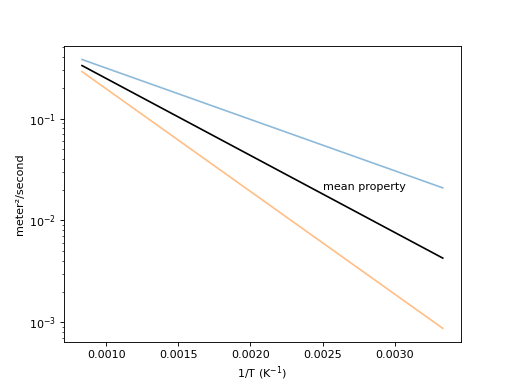
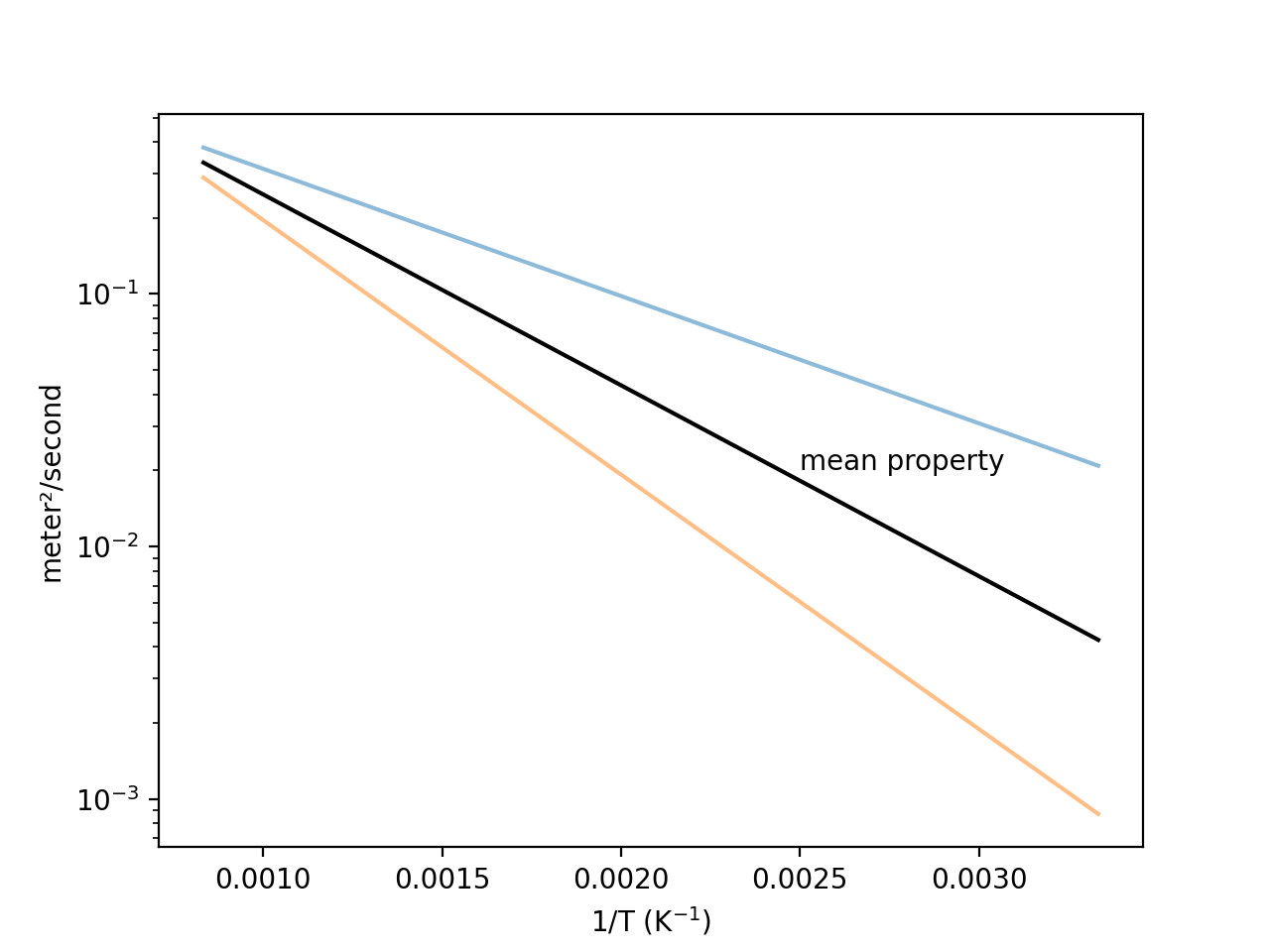
With PropertiesGroup() objects, it is possible to compute the mean property using the mean() method.
import h_transport_materials as htm

prop1 = htm.Diffusivity(1, 0.1)
prop2 = htm.Diffusivity(2, 0.2)

group = htm.PropertiesGroup([prop1, prop2])
mean_property = group.mean()

print(mean_property)
Author:
Material:
Year: None
Isotope: None
Pre-exponential factor: 1.41×10⁰ m²/s
Activation energy: 1.50×10⁻¹ eV/particle
(Source code, png, hires.png, pdf)